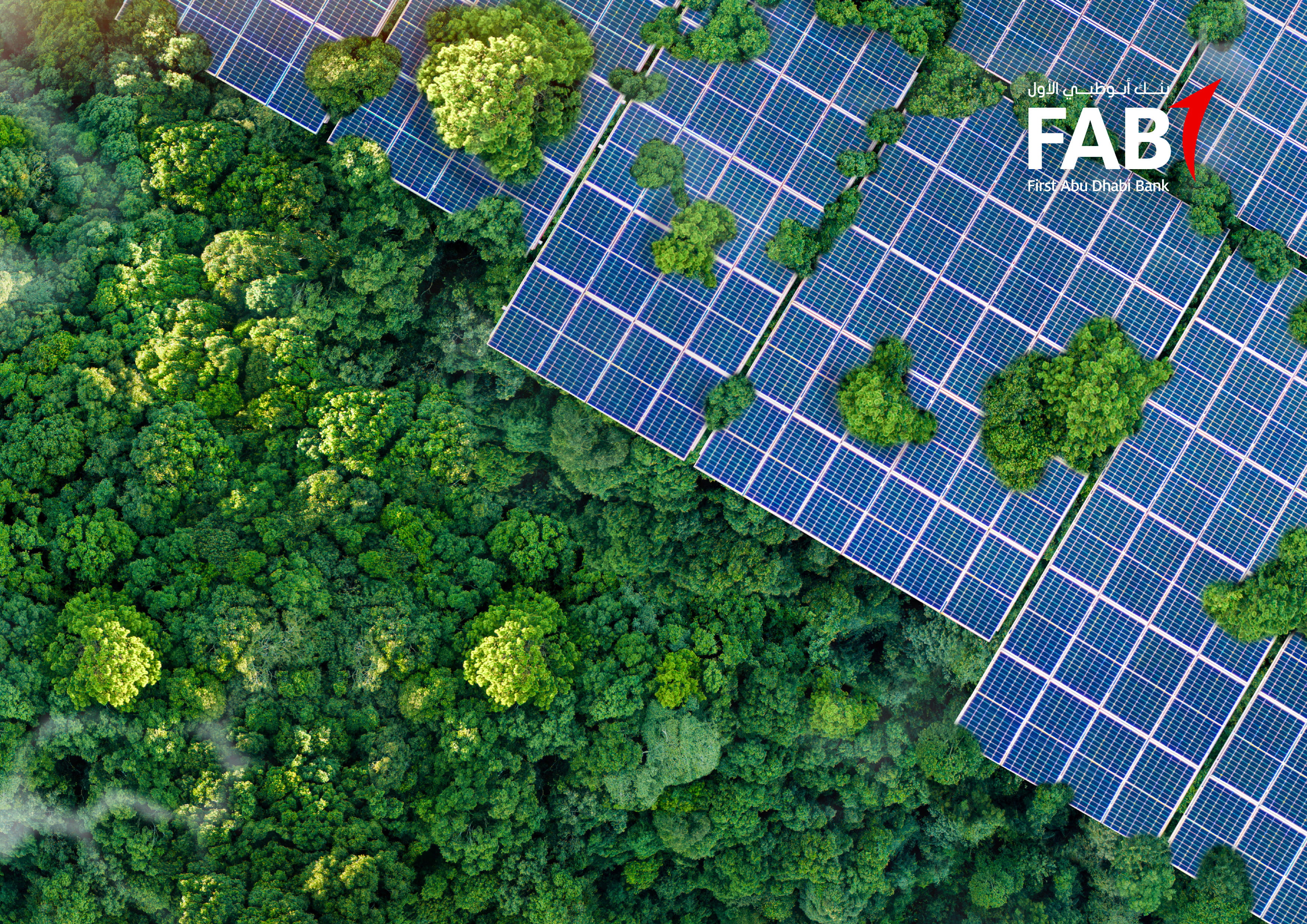
FAB continues to align its strategy with national climate priorities, embedding sustainability across its business model, risk framework, and client engagement approach. At the core of the plan are four pillars: Client Engagement and Sectoral pathways, Climate Risk Management and Portfolio Steering, Operational Decarbonisation and Sustainable Finance Mobilisation.
The report outlines FAB’s approach to measuring, managing and reducing climate and nature‑related impacts across its operations and financing portfolio. It also demonstrates how the Bank is translating its net zero and nature‑positive commitments into tangible, measurable actions.
Key highlights include:
- Continued progress on operational decarbonisation: FAB reduced Scope 1 and 2 emissions intensity per FTE by 35% since 2019. This has been driven by energy‑efficiency initiatives, increased use of cleaner grid electricity, and the integration of clean energy certificates across key locations. A formal net zero action plan has been established to deliver the Group’s 2030 operational decarbonisation targets.
- Structured transition maturity assessment to enhance client engagement: FAB introduced a bespoke transition maturity assessment and escalation framework, enabling more targeted, risk‑based engagement with high‑emitting clients. Coverage under this framework is being progressively expanded, with the number of assessed clients expected to double between 2024 and 2025.
- Improving momentum on financed emissions across priority sectors: FAB remains on track against its 2030 pathways across eight high‑emitting sectors, supported by improved client disclosures and early transition actions. Financed‑emissions pathways have been re‑baselined to 2023 from 2021, strengthening credibility and alignment with the current portfolio while reinforcing the bank’s medium‑term decarbonisation trajectory.
- Advanced climate mitigation financing: FAB mobilised AED 114.4 billion in sustainable and transition finance in 2025, directed toward climate mitigation solutions such as renewable energy, energy efficiency, green buildings and clean transport, as well as climate adaptation initiatives.
- Strong progress towards FAB’s AED 500 billion sustainable and transition finance target: Since 2022, FAB has facilitated AED 381 billion in sustainable and transition finance, achieving 76% of its AED 500 billion 2030 target and reinforcing its role in financing the transition to a low‑carbon economy in line with the UAE’s and global climate and nature commitments.
- Strengthened sustainable finance leadership: FAB issued landmark transition‑labelled instruments, including the first low‑carbon energy bond globally and the first blue bond by a GCC financial institution, supporting energy transition, water and wastewater infrastructure.
- Integration of nature into financing and risk decisions: FAB published the region’s first TNFD‑aligned disclosure, issued blue bonds aligned with ICMA principles, and expanded nature‑related risk considerations within its ESG assessments and sectoral policies, strengthening sustainability in banking and supporting a nature‑positive future.
- Leadership in global nature and biodiversity dialogue: FAB served as Principal and Official Banking Partner of the IUCN World Conservation Congress 2025, advancing discussions on nature finance, biodiversity, water, and the climate‑nature nexus in collaboration with governments, investors and clients.
- Delivery of tangible nature‑positive impact: In Abu Dhabi, FAB supported coral reef restoration through partnerships with Archireef and the Environment Agency – Abu Dhabi (EAD), deploying 400 reef tiles and transplanting 800 coral fragments to support marine ecosystem recovery.
Shargiil Bashir, Group Chief Sustainability Officer at First Abu Dhabi Bank, said: “The 2026 Transition Pathways Update demonstrates how FAB is embedding transition across every facet of our business, from our own operations to our client relationships and capital allocation. In line with the UAE’s climate ambitions, we are committed to supporting a low-carbon, nature-positive future through disciplined decarbonisation, structured client engagement, and scaled sustainable finance. This approach enables us to drive a responsible transition while creating long-term value for our clients, communities and the broader economy.”
The 2026 Transition Pathways Update forms part of FAB’s ongoing commitment to transparent climate and nature‑related disclosures and supports stakeholders in assessing the bank’s progress against its transition strategy and 2030 targets.
For more details, the full report can be accessed here: Reports, Policies, and Frameworks | First Abu Dhabi Bank - UAE.


 Login
Login